How AI guided dating helps Gen Z and late millennials find the right partner
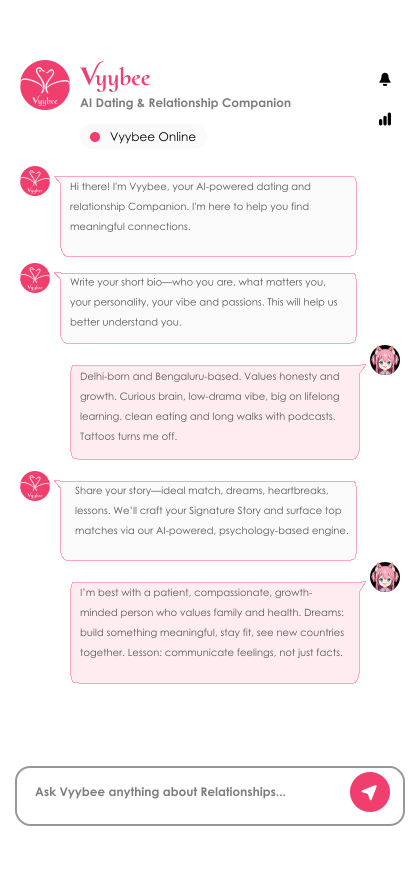
AI guided dating gives Gen Z and late millennials fewer and better matches by blending psychology, embeddings, and gentle conversation coaching. It weaves culture, language, and life aspirations into matching while protecting privacy, promoting fairness, and guarding safety in chat. The result is less noise and more genuine connections.
7/22/20252 min read


Why it matters now
Gen Z and late millennials date in an environment of constant choice, rapid feeds, and limited attention. Decision fatigue encourages quick judgments and superficial selection. Artificial intelligence designed with psychology and ethics reduces noise, highlights people who fit your values and life rhythm, and supports healthier conversation. The aim is not to replace human judgment. The aim is to create fewer and better beginnings.
The foundation
A strong system rests on validated constructs such as the Big Five, attachment patterns, conflict styles, and life rhythm. Assessments should be adaptive and brief, with reliability checks across diverse groups. Cultural meaning matters as well. Algorithms and prompts should weave languages, festivals, food, traditions, life aspirations, and career journeys so matches feel authentic.
How it works
Profiles, prompts, interests, and short conversation snippets are converted into dense vectors that capture meaning. The system estimates affinity with a weighted combination of similarity between two people, overlap in values, and a prediction of conversational fit. Ranking is two sided and optimizes for mutual interest and mutual wellbeing. Constraint layers respect deal breakers and context before any ranking begins. Guidance components generate context aware prompts, gentle nudges, and a concise preview of likely chemistry.
Discovery and conversation
Discovery should be vibe first rather than feed first. A small set of considered introductions each week reduces impulsive rejection and preserves attention for real possibilities. A brief pre connection glimpse can outline shared values, likely friction points, and a suggested tone for the first hello. During chat, micro coaching can nudge empathy and clarity. If one person prefers directness and the other warmth, the system can suggest appreciation first and request second.
Safety fairness and privacy
Bias audits should measure outcomes across gender, region, religion, caste, and language groups. Re ranking can correct popularity cascades. Sensitive fields should default to private with granular controls. When feasible, verification signals should run on device. The system should explain why a match was suggested in plain language and allow people to tune weights toward chemistry, values, or lifestyle fit. Real time detection should flag harassment, coercion, or financial grooming and offer one tap boundary templates and resources.
Success and next steps
Measure discovery quality through mutual intent rate, diversity of surfaced attributes without tokenism, and time to first meaningful introduction. Measure conversation health through symmetry of response time, depth of exchange, and repair after small ruptures. Measure relationship outcomes through first meet conversion, second meet retention, three month satisfaction check ins, and a steady decline in safety incidents. Use A B testing for prompts and ranking changes, survival analysis for relationship persistence, and propensity matching to isolate true effects. Keep a human in the loop for sensitive cases and run regular qualitative research with diverse user panels.
Closing thought
When designed with care, AI does not gamify love. It de gamifies it. By reducing noise, honoring culture and values, and coaching healthier dialogue, it helps Gen Z and late millennials focus on what matters most. Not faster swipes, but fewer and better beginnings.